
Konstantinos Gerardos
Is a dancer teacher, choreographer and the artistic director of VIS MOTRIX DANCE COMPANY, which is based in Thessaloniki/Greece. He runs VIS MOTRIX PERFORMANCE STUDIO, a space for contemporary dance, performance and theatre in Thessaloniki and he is the creator and educational director of ReDance, an educational program in contemporary dance and performance for actors and dancers.
He started dancing at the National School of Dance in Athens when he was 11 years old. He continued his studies at the Morianova Professional Dance School and graduated from the Professional Dance School of Stavroupoli in Thessaloniki.
Between 1989 and 2004 he danced for the Thessaloniki Dance Theatre (National Theatre of Northern Greece). In 2001 he won the 1st prize at the National Awards for Dance for his interpretation as ‘Bluebeard’ at the performance of the same name, directed by K. Rigos. In 2012 he was invited by the ‘Machinenoisy Dance Company’ based in Vancouver, Canada to dance at the performance ‘Romantic Old Horses’ directed by Peter Bingham. His career as a dancer has continued until today.
In 2001, he founded his own company, ‘VIS MOTRIX DANCE COMPANY’ based at the Vis Motrix Performance Studio in Thessaloniki and has been creating and directing its performances (In Dreams, Safety Distance, Pessoas, In Between, Nocturne, Void, Dark Matter(s) and others) in Greece and abroad (Great Britain, Germany, Spain). In May 2015 Konstantinos Gerardos directed the performance ‘TAN’ for the Thessaloniki Dance Theater (National Theatre of Northern Greece). He has also worked as an actor for the ‘Nees Morfes’ Theatre Company and as a choreographer for theatre and opera and has been subsidized for his work by the Greek Ministry of Culture.
During his work as a dancer and choreographer for the past 30 years, Konstantinos Gerardos has also developed a great teaching experience in classical and contemporary dance, improvisation and Contact Improvisation, Partnering, Ensemble Improvisation, composition, choreography and performance in professional dance schools and acting schools. He has taught improvisation and choreography at the Dance and Performance course at the University of Lincoln in England and workshops in contemporary dance and contact improvisation in Spain, Germany, Israel and Canada. He has collaborated with Chris Aiken, Angie Houser Kirstie Simpson, Nita Little, Ray Chung, Eckhard Muller, Gregor Weber, Thomas Mettler, Yaniv Mintzer and many others.
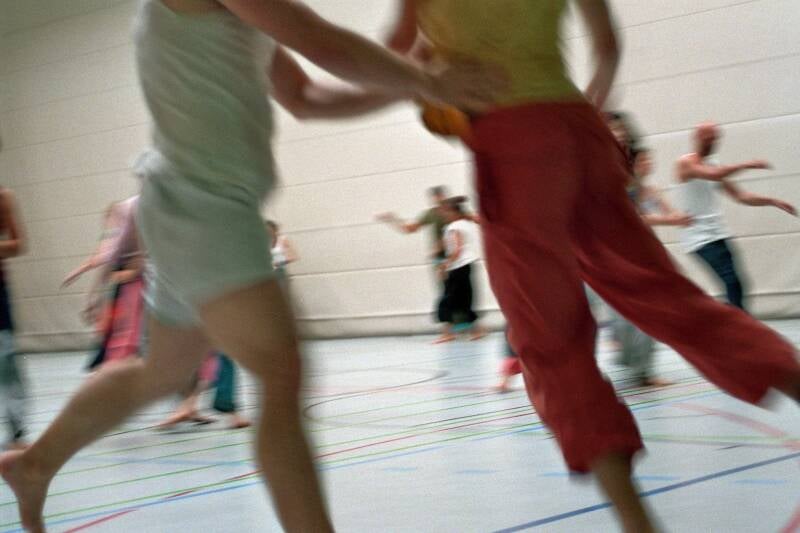
Description of the first Workshop
Holding and Carrying | Contact Improvisation Intensive
How can we support another body's weight without straining our own? How does a simple "hold" transform into a fluid, continuous dance?
"Holding and Carrying" is an intensive workshop dedicated to the art of Lifting and Supporting within the practice of Contact Improvisation. Throughout this workshop, we will shift our focus away from muscular effort and toward the smart use of skeletal alignment, gravity, momentum, and breath.
We will explore how to offer a safe, stable base (holding) and how to transport (carrying) our partner through space while maintaining the organic flow of the improvisation.
What We Will Explore (Core Themes)
-
The Anatomy of Support: Activating the core, utilizing skeletal structure, and using the floor as the primary source of power for every lift.
-
The Art of Holding: How to embrace and cradle another's weight safely, eliminating unnecessary tension in the shoulders and neck.
-
Fluid Lifts & Flight: Finding the right timing and a shared center of gravity to offer or receive "flight," making lifts feel effortless and airborne.
-
Listening & Trust: Cultivating deep listening through skin contact, ensuring that transitions to and from the air are rooted in mutual trust.
Second workshop Description
The Soloist - Behind the Contact: Autonomy and Availability in Movement Improvisation
Description
Often, Contact Improvisation dancers become trapped in the need for "the other" body to generate movement, losing their personal kinetic identity and the structure of their Solo. This workshop is addressed exclusively to Contact dancers, but shifts the center of gravity from the "Together" to the "I".
The goal is to deconstruct the automated movement loops (habits) created by the continuous flow of touch. We work on skeletal architecture, peripheral vision, gear shifts, and absolute physical readiness. We will not touch. Instead, we will share the same space, sharpening reflexes, availability, and the capacity for Instant Composition.
We will deepen on:
Skeletal Architecture and Availability
Focus: The soft yet powerful body, grounding, and releasing the spine as an autonomous motor.
-
Tuning & Bone Structure (Articulating the Spine): Activation of the skeletal system. Working with gravity and the floor. How a body remains "soft" without losing its structure. Anatomical awareness of the spine as an axis supporting three-dimensional movement in space.
-
The Solitary Flow (Breaking the Loops): Isolation of personal movement patterns. Constraint-based exercises to avoid the classic trajectories used by a Contact dancer (rolling, specific angles). Searching for the raw, unpredictable movement of the solo.
-
Space & Peripheral Awareness: Contact dancers tend to focus their gaze and attention on the touchpoint. Here, we open the peripheral vision. Dancing with focus on negative space (the gaps between bodies) and the architecture of the room.
-
Integration & Feedback: Brief review and archiving of physical information.
Time, Rhythm, and Instant Composition
Focus: Time management, stillness, the sudden, and the ability to make compositional decisions in a split second.
-
Re-activation & Dynamics (Speed vs. Stillness): Fast warm-up focusing on dynamic shifts. Working with contrasts: From absolute speed to instantaneous pause (stillness). Cultivating the reflexes required in a jam, without using physical contact.
-
Spatial Geometry & Trajectories: Moving in straight lines, curves, and spirals. How the body can fill the space and become visible and precise. Clarity of intent before any encounter occurs.
-
Scores of Instant Composition: Application of structured improvisational scores. Participants compose in real time using tools such as time, repetition, contrast, and hijacking movement material from the environment. The body is available to receive stimuli and respond immediately.
-
Closure: Discussion on how the acquired autonomy transfers back into the practice of Contact Improvisation.